第2回国際シンポジウム開催(プログラム生レポート)
Mi ZHAOさん(M2)
 After staying on the airplane for nearly seven hours, we stepped on the land of Vietnam in the evening of December 14th.
It was the fi rst time to Vietnam for most of us. Although we were a little tired, every one of us was still very excited.
Our guide welcomed us at the airport of Ho chi Minh City and took us to our hotel by bus.
On the way to the hotel, many students took out their cameras to record the amazing night scenes along the roads.
The guide told us that people in Vietnam were used to “living outside” in the evening to enjoy the soft winds during the hot days.
They liked to sit on the roadside to have their meals, talk with their neighbors and friends, and kill time after a busy and tiring day.
I could see many happy faces beside the roads and imaged that we would have a wonderful experience in Vietnam.
After staying on the airplane for nearly seven hours, we stepped on the land of Vietnam in the evening of December 14th.
It was the fi rst time to Vietnam for most of us. Although we were a little tired, every one of us was still very excited.
Our guide welcomed us at the airport of Ho chi Minh City and took us to our hotel by bus.
On the way to the hotel, many students took out their cameras to record the amazing night scenes along the roads.
The guide told us that people in Vietnam were used to “living outside” in the evening to enjoy the soft winds during the hot days.
They liked to sit on the roadside to have their meals, talk with their neighbors and friends, and kill time after a busy and tiring day.
I could see many happy faces beside the roads and imaged that we would have a wonderful experience in Vietnam.
The Symposium was opened on December 15th at Ho Chi Minh City University of Technology by Professor Tohji from Tohoku University and Professor Truong Chi Hien from Ho Chi Minh City University of Technology.
During the presentation hours, professors and students from both of the two universities shared their research experience orally or through posters.
All of the presentations were interesting and impressive.
Among them, the presentation given by Professor Takahashi from Tohoku University moved me most.
He talked about the creation of artificial ground with the Fiber-Cement-Stabilized Soil Method by recycling tsunami sludge left from the big earthquake on March 11th.
He did very hard and meaningful work after the disaster. Now, they have already carried out the recycling of tsunami sludge in Kesennuma city inMiyagi Prefecture from October 26th to November 2nd.
In addition, they would like to release the information of the actual process widely and contribute to the restoration and reconstruction of disaster places.
Additionally, the presentations given by students from Vietnam were also very excellent.
They were mainly about wastewater treatment and water quality assessment.
Although they were undergraduate students, their serious attitude towards science research and wonderful ideas and work left deep impressions on us.
最首 花恵さん(D1)
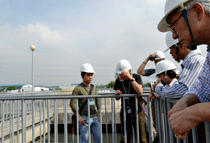 Binh Hung 下水処理場は大きく立派な施設で、匂いもあまり気にならず、始めは日本の下水処理場と同じレベルのような印象をうけた。
お話を伺うと,下水処理規制が日本よりゆるいこと、道路に放置されているゴミが処理の過程でつまってしまうことなど、まだ課題は多いことが分かった。
ホーチミン市で最大唯一の処理場であるとのことだったが、それでもホーチミン市の10%しかまかなえないという現状に関しては、下水処理能力の点というより、ホーチミン市にいかにたくさんの人が住んでいるかという点で驚いた。
今回の訪問で、ベトナム特有の水環境の一端を知ることができたと思う。
これからホーチミン市は若者がたくさん集まり、どんどん繁栄していくと思われるが、それと同時に都市環境整備にも多くの市民が関心を持ち、その風潮が社会全体に浸透しているような街になってほしい。
Binh Hung 下水処理場は大きく立派な施設で、匂いもあまり気にならず、始めは日本の下水処理場と同じレベルのような印象をうけた。
お話を伺うと,下水処理規制が日本よりゆるいこと、道路に放置されているゴミが処理の過程でつまってしまうことなど、まだ課題は多いことが分かった。
ホーチミン市で最大唯一の処理場であるとのことだったが、それでもホーチミン市の10%しかまかなえないという現状に関しては、下水処理能力の点というより、ホーチミン市にいかにたくさんの人が住んでいるかという点で驚いた。
今回の訪問で、ベトナム特有の水環境の一端を知ることができたと思う。
これからホーチミン市は若者がたくさん集まり、どんどん繁栄していくと思われるが、それと同時に都市環境整備にも多くの市民が関心を持ち、その風潮が社会全体に浸透しているような街になってほしい。